

Nataly Dubbelman, Metrosert’s Quantum Technologies Coordinator, is not a quantum physicist, nor does she try to present herself as one. Her strength lies elsewhere: she can dive headfirst into a complex field, find the right people and bring them together around the same table. This is exactly the kind of connector needed in a field where Estonia already has strong expertise and growing interest, but where a fully developed ecosystem is still taking shape.
Just a few years ago, quantum technology meant something close to rocket science to Nataly – something highly complex and distant that she had barely even heard of. It was therefore even more unexpected that, after working in real estate, tourism, green technology and aviation, she would one day find herself coordinating the development of this very field.
“When I saw the job advertisement, I did not think for a moment that the position could be for me,” Nataly admits, laughing. “I found the courage to apply when a former colleague who worked at Metrosert explained that they were looking first and foremost for a strong communicator and someone with courage, rather than a quantum physicist with a PhD. The scientists and experts already existed, but someone was needed to handle the coordination, communication, background research and writing.”
Diving Headfirst into the Unknown
When Nataly joined Metrosert, she was not given much time to test the waters. Within her first few days, she learned that a major annual international conference in the field was coming up and that she would be expected to represent both Metrosert and Estonia there. At almost the same time, she was also due to attend her first meeting of a NATO working group on quantum technologies.
“To put it mildly, I was confused – what was I supposed to say if someone asked me something?” she recalls. “But I prepared thoroughly, and once I arrived, I realised it was the best possible place to quickly understand who was active in the field and what people were discussing. I was given an exceptionally warm welcome. I did not have to pretend. I said honestly that I was new to both the field and the role, asked people to help me and introduce me to others. That is how my network began to form from the very first day of the conference.”
During her first six months, she took part in European working groups discussing input for the European quantum strategy. This quickly gave her an overview of the investments being made by other countries and the capabilities they were developing.
“In the beginning, the uncertainty was enormous. By now, I have a much clearer sense of what my role is, what knowledge I need myself and where I can turn for expert input. My task is to know enough to ask the right questions, recognise connections and bring the right people together.”
A Brave Child Who Was Never Very Good at Saying No
Diving into unfamiliar environments is nothing new for Nataly. She grew up in Haapsalu and attended a school with a strong emphasis on mathematics, although she certainly did not dream of a career in a research-intensive field.
“I was extremely sociable, talked constantly and was curious about everything. I studied piano at music school because my mother thought I should do something with music, but to be honest, I hated music school. I enjoyed dance school much more.”
As a teenager, Nataly took her first major leap into the unknown when, at her parents’ suggestion, she enrolled at Noarootsi Gymnasium. As the school operated largely as a boarding school, the move meant that at the age of 16, having grown up in a Russian-speaking family, she left home, moved into a flat with seven other girls and began studying in an Estonian-language environment.
“In addition to always being brave and curious, I have never been particularly good at saying no. When my mother presented the idea of going to Noarootsi, I thought: alright, let’s do it,” she recalls.
Nataly did not need much time to consider her options when an opportunity arose to spend time in Sweden as an exchange student either. She accepted the challenge, and it turned into a highly memorable adventure.
When choosing a specialty for university, Nataly eventually settled on real estate management at TalTech and worked in the field for a short time. Although she was good at the job and was responsible for sites including the Bank of Estonia building, Stroomi Beach and Glehn Castle, she soon realised that real estate management did not offer enough excitement for her in the long term. She was more interested in people than buildings, and her career subsequently took her into tourism, customer relations and team management.
“When I look back at my career, the common thread has always been people, relationships, organisation and coordination. You could say that I am a kind of ‘relationship manager’, although not in the traditional sense of the job title. My work has been about understanding who needs what information, who should be speaking to whom, and how to make a complex subject understandable.”
Believing in Big Ideas
An important stop along the way was the green technology start-up Single.Earth, whose ambition was to connect the value of nature, sustainability and a blockchain-based economic model. At first, the idea sounded almost unbelievably futuristic.
“I still sometimes wonder how the founders managed to sell the idea so convincingly to us and to investors,” Nataly laughs. “It sounded completely outlandish: a cryptocurrency based on the value of living nature. Yet we all embraced it with great enthusiasm. I love big ideas and become excited very quickly, especially when I feel that something could represent the future.”
At the start-up, she first had to understand the complex concept herself and then translate it for customers and partners. The experience taught her how to talk about something that does not yet fully exist, while helping others understand its potential.

The Question Is No Longer “If” but “When”
A few decades ago, quantum computers may have seemed like pure science fiction. Today, major countries are investing billions in the field. According to Nataly, the question is no longer whether quantum technologies will enter wider use, but when this will happen and which applications will emerge first.
The development of quantum technologies also raises major security concerns. A sufficiently powerful quantum computer may one day be able to break the encryption methods currently in use, potentially affecting the security of communications and power systems, among others. NATO, the European Union and the OECD are already preparing for this moment, known within the community as Q-Day. Nataly represents Estonia’s interests in working groups at all three levels.
“We cannot wait until the technology is ready and only then start asking what we should do,” Nataly emphasises. “Just five years ago, most people could not have imagined how quickly artificial intelligence would begin to affect our work and everyday lives. The impact of quantum technologies may likewise reach us through the systems and services we depend on every day.”
Her role is to serve as a link between researchers, companies, international partners and the state. Researchers are not always able to participate in every international working group or respond to all partnership enquiries. Nataly gathers information, directs it to the right people and, when necessary, brings in colleagues and experts with deeper quantum expertise.
“The real value is created by researchers and specialists in their respective fields. “My role is to build connections within the quantum community, create opportunities for collaboration, and bring together the right people, knowledge and expertise.”
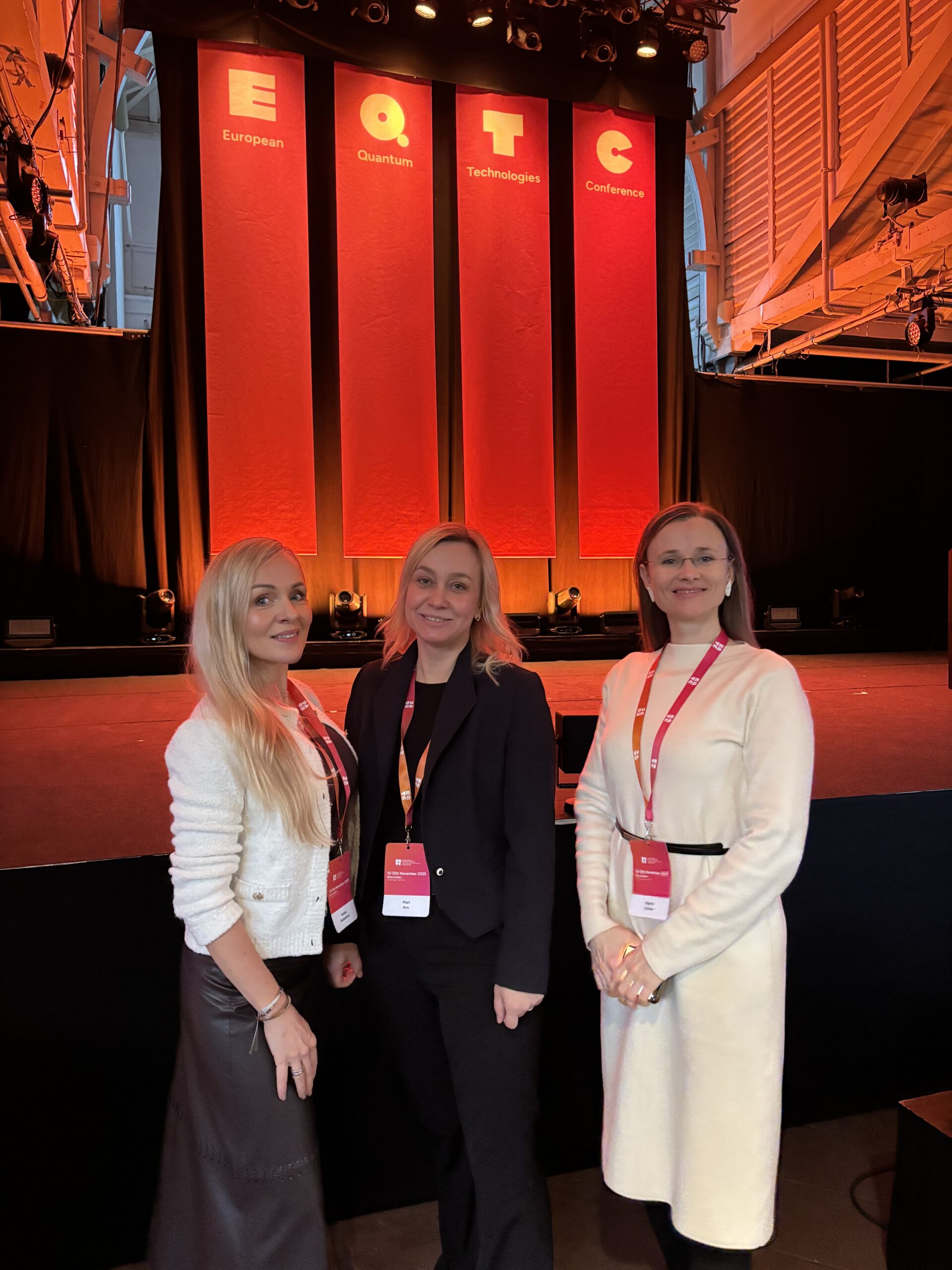
The people working in the quantum field have been one of the biggest surprises for Nataly since entering this new area. She had imagined quantum researchers as serious people speaking in highly technical scientific language that ordinary people would struggle to understand.
“The experts I have had the privilege of working with are awesome!” she says. “They have remarkably broad perspectives and can explain their field in such an engaging and accessible way that even a child could understand the main idea. Many of them are excellent communicators with a fantastic sense of humour.”
A Community Begins to Take Shape
Nataly joined Metrosert at a time when Estonia had already begun mapping its quantum researchers and existing capabilities. Her task was to broaden the network by bringing in companies and international partners. One of the first meetings she organised was held in cooperation with the European Space Agency.
“After the meeting, one participant came up to me and said that, for the first time, it felt as though something was genuinely beginning to happen in Estonia’s quantum technology field. That was a very important moment for me. When you have spent a long time writing to people and organising meetings, you want to see whether something actually comes from it.”
This success was followed by meetings with companies and the Estonian Association of Information Technology and Telecommunications, as well as Estonia’s first quantum computing hackathon. The event brought together real business challenges, students, researchers and international mentors. The strong interest demonstrated that young people and technology companies are ready to explore the field.
Metrosert is currently preparing Estonia’s quantum technology roadmap, which aims to identify areas where the country has a realistic opportunity to develop its own niche.
“There is no point in trying to do everything at once. We need to identify the areas where we already have knowledge and strengths on which to build. Other countries are already investing heavily in the field and preparing for the future, and we cannot afford to fall behind. At the same time, it is important to understand that change does not happen overnight. Developing a new field takes time.”
Metrosert as a Hub for Emerging Technologies
Nataly sees Metrosert as a natural coordinator of this work. In addition to quantum technologies, the organisation brings together chip and drone technologies and several other emerging fields. At the same time, Metrosert’s historical foundation lies in metrology, precision measurement and the maintenance of Estonia’s national measurement standards.
These worlds are becoming increasingly interconnected. The rapidly developing fields of quantum sensors and quantum metrology are opening up entirely new possibilities for exceptionally precise measurements, and Metrosert’s laboratories are already taking their first bold steps in these areas.
“It is sometimes amusing to think that hardly a day goes by without people encountering Metrosert’s work in one way or another. When you weigh bananas in a shop, someone must have verified that the scale is accurate. When you fill up your car, a litre must actually be a litre,” she says, illustrating the importance of Metrosert’s work.
Nataly says she now feels a great sense of pride in Metrosert and its team.
“It is awe-inspiring to see the remarkable things being done here. People carry out their work with genuine dedication and exceptional professionalism. On the one hand, we safeguard decades of accumulated precision and expertise; on the other, we are building something entirely new.”
A Skydive Is Easier Than Giving a Presentation

Outside work, Nataly’s life revolves around travel, reading, friends, family, the gym and dancing, with folk dancing being her newest hobby. She has been an avid reader since the age of five and currently tends to bring home Scandinavian crime novels from the library. Salsa has brought her great joy over the past three years, and a year ago she also took up folk dancing, encouraged by her active colleagues at Metrosert.
“I have set myself the goal of being in the best shape of my life by my fiftieth birthday. I want to look after my health so that I can still travel and dance when I am eighty.”
A few years ago, she gave herself a skydive as a birthday present. It might seem that someone so daring would be afraid of nothing, yet there is at least one thing that genuinely frightens Nataly: public speaking.
“I am usually the life and soul of the party, but when all eyes are on me and I have to stand alone in front of an audience, it becomes difficult. I do not want to be the person on stage pretending to know more than I actually do.”
Fortunately, nearly two years in the quantum world have taught her that confidence does not mean having all the answers. It is far more important to know how to ask questions, find the knowledge you need and bring the right people together.
“If Metrosert’s job advertisement had been looking for a quantum technology expert, I would never have applied. Fortunately, they were looking for someone who could communicate, coordinate and get things moving. Even a highly research-intensive field needs people with different professional backgrounds. Metrosert is a place for curious and honest people from any walk of life who are willing to learn and ask for help when needed. Sometimes you simply have to take the plunge. The swimming skills will follow.”