
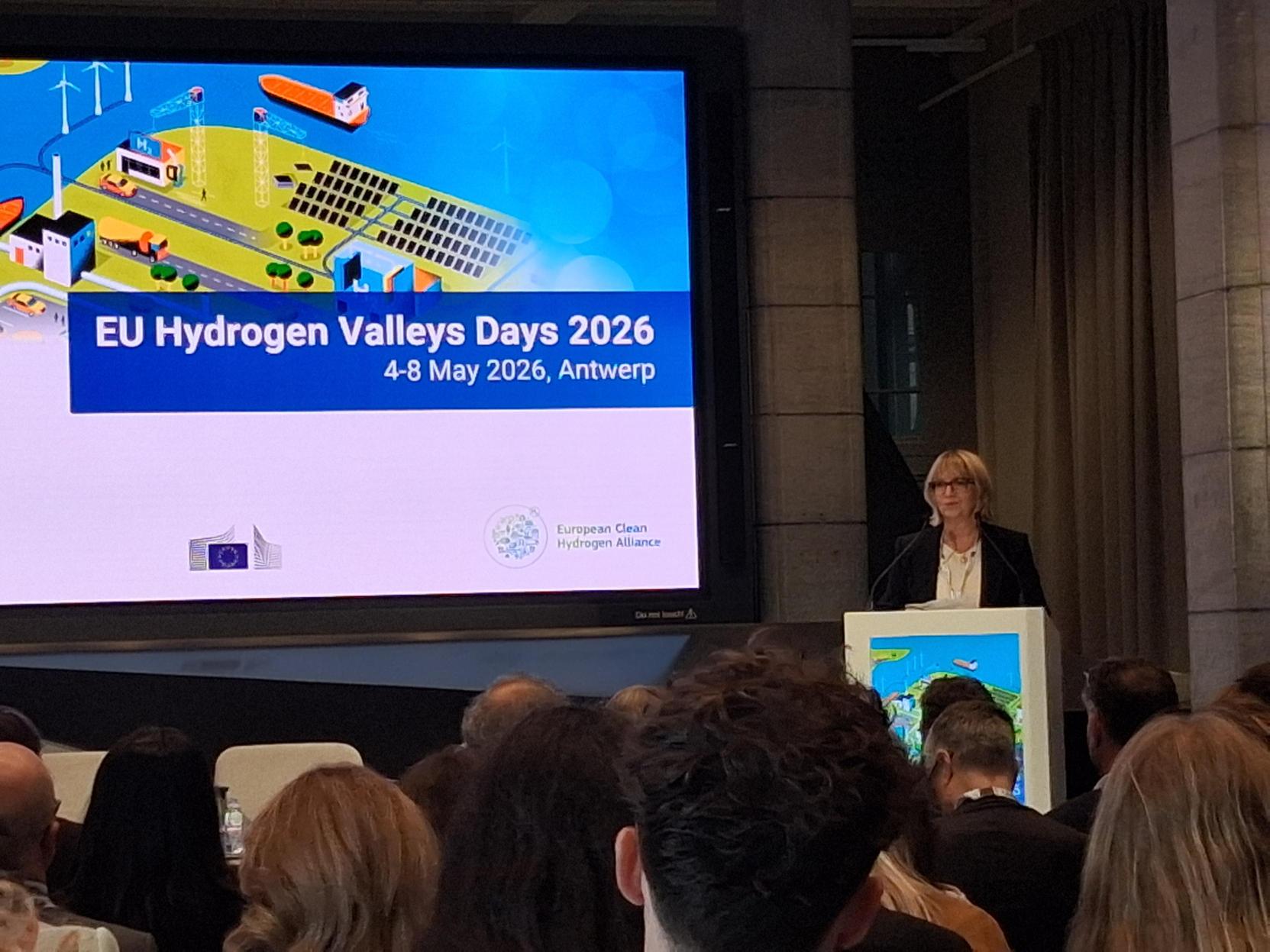
The third Hydrogen Valleys Days, held in Antwerp, Belgium, from May 4–8, 2026, convened international experts, policymakers, and industrial leaders. The central theme of the event emphasized that the European clean hydrogen ecosystem has moved beyond the planning phase toward the physical construction of market value chains. Metrosert was represented by Ly Lepik, Hydrogen Technologies Project Manager and Coordinator of Hydrogen Valley Estonia, with the objective of mapping applied research directions, identifying technological requirements, and strengthening Estonia’s position within international networks.
Focus on Production and Technological Sovereignty
Europe has adopted a strategic direction toward technological sovereignty. The “Made in Europe” principle, supported by the recently enacted Net-Zero Industry Act, aims to produce at least 40% of Europe’s required clean technologies—including electrolysers, fuel cells, and essential components—within the region. This measure is intended to mitigate dependencies on non-European supply chains.
A significant challenge remains the high production cost of renewable hydrogen. Discussions in Antwerp highlighted that solutions require not only public subsidies but also radical standardization of equipment and increased automation in manufacturing. During the transition period, the EU has authorized the use of low-carbon hydrogen to facilitate the establishment of critical infrastructure and capacity before 100% renewable energy capacity is fully realized.
Infrastructure and Demand Generation
Hydrogen valleys and industrial hubs are evolving from isolated pilot projects into integrated pillars of a pan-European market. Infrastructure development follows an “inside-out” approach: localized production is first connected to major ports and industrial complexes (such as the Antwerp-Rotterdam-Rhine-Ruhr region), followed by integration into a broader network. A significant regulatory milestone is the launch of ENNOH, which will centrally manage the European Hydrogen Backbone. This framework is designed to ensure transparent competition and standardized tariffs for cross-border transport.
On the demand side, the EU focus remains strictly on Hard-to-Abate sectors. As renewable electricity and hydrogen are finite resources, they are prioritized for industries where direct electrification is not technically feasible, such as steel and chemical manufacturing, as well as heavy-duty transport (maritime and aviation). To mitigate price risks for industry, financial instruments such as the European Hydrogen Bank (EHB) auctions and the H2Global brokerage model have been implemented, utilizing state-guaranteed Contracts for Difference (CfD) to align producer and off-taker expectations.
Strategic Steps for Investment Certainty
To ensure hydrogen projects reach a Final Investment Decision (FID), five critical action areas were identified:
- Regulatory Simplification: Implementing the mandates of the Net-Zero Industry Act and the Industrial Accelerator Act to reduce permitting timelines for hydrogen projects from several years to a maximum of 12–18 months.
- Certification and Standards: Rapid harmonization of RFNBO (Renewable Fuels of Non-Biological Origin) rules and Guarantees of Origin to provide transparency regarding the carbon footprint of purchased hydrogen.
- Regional Cooperation and Estonia’s Role: Coordinated planning of cross-border projects. For Estonia, the Nordic-Baltic Hydrogen Corridor and the Baltic Sea Hydrogen Collector are vital. These corridors enable the conversion of regional wind energy potential into hydrogen for export to Central European industrial markets.
- Scaling Innovation: Advancing technologies, such as high-temperature SOEC electrolysers and long-term hydrogen storage, from laboratory environments to megawatt and gigawatt scales through public-private co-financing.
- Social Dimension: Developing human capital in tandem with technology. The transition requires collaboration with academic institutions to reskill the workforce for specialized roles in hydrogen engineering and maintenance.
Hydrogen Valley Estonia is an officially registered regional hydrogen valley, with development and activities coordinated by AS Metrosert. Further information regarding the development of the Estonian hydrogen economy is available at www.hve.ee.