
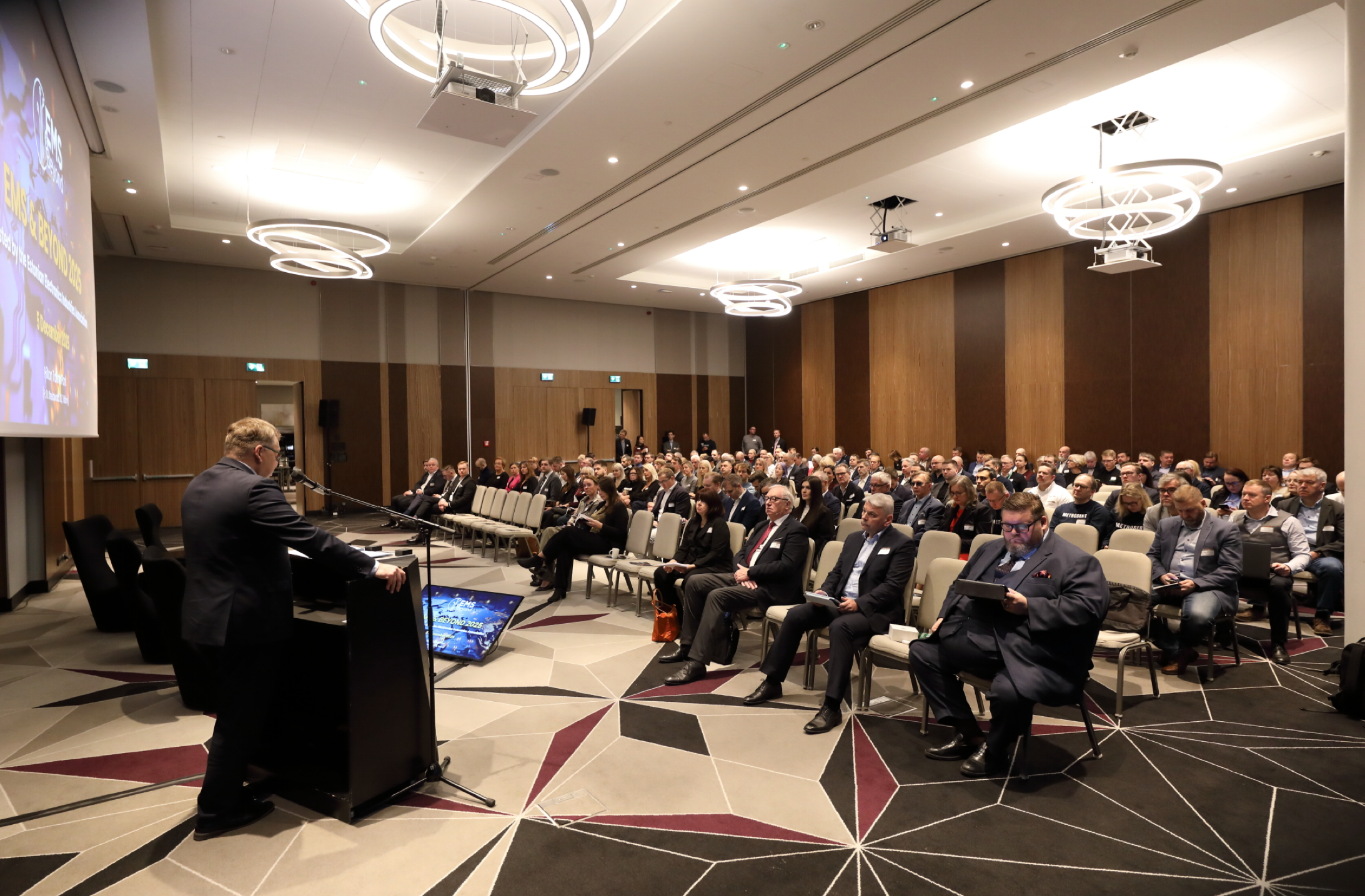
The Estonian electronics industry is ending the year in a clear growth phase: orders have increased in the fall, companies are investing in innovative technologies, and the focus is increasingly shifting to higher value-added solutions. The international seminar “EMS & Beyond 2025” held in Tallinn on Friday, December 5, brought these trends into sharp focus, especially in connection with the launch of the new chip technology competence center KIIP.
Arno Kolk, CEO of the Estonian Electronics Industry Association, emphasized that by the end of 2025, the market will have clearly returned to growth. According to him, “orders have increased in the fall and the market has been on an upward trend,” reflecting customer confidence and companies’ willingness to take on larger projects. Companies are investing more and more resources in automation, digitization of production processes, and quality control solutions to meet the growing demand for high-tech products. According to Kolk, this is not just a short-term recovery, but a structural change in which Estonian manufacturers are moving from simple assembly work to more complex and knowledge-intensive solutions.
The birth and growth of the Chip Center in 2025
Much more than in previous discussions, this time the focus was on KIIP, the Estonian chip technology competence center operating in the drone technologies unit at the Metrosert Application Research Center, which is rapidly becoming one of the key initiatives in the Estonian electronics and technology sector. The center brings together chip development, testing, and reliability assessment capabilities under one roof, linking the expertise of the state, universities, and companies. Arno Kolk described KIIP as “the engine of innovation for the entire sector.” “It gives a strong boost to innovation across the sector and enables Estonian high-tech companies to take their products to a new level,” he said.
Although KIIP is officially still in its start-up phase, the center’s impact is already being felt. The chip center has consulted with 15 Estonian companies, helping them assess which products and business models are suitable for chip development, what the technical and regulatory risks are, and what resources are required. KIIP is part of a broader European network that aims to strengthen the chip development competence of member states and reduce dependence on solutions from outside Europe.
According to Kolk, the sector’s long-term competitiveness is ensured by strong growth: “Enrollment numbers in engineering education are consistently high, and interest in electronics education is growing. Our campaign ‘Study electronics!’ has attracted new students to the field, which gives us confidence that there will be enough top specialists in the sector in the future.” Links between universities and industry are strengthening as companies increasingly seek opportunities to involve students in development projects while they are still studying.
Experts from 19 countries
The “EMS & Beyond 2025” seminar held in Tallinn on Friday brought together 230 electronics industry experts from 19 countries, highlighting Estonia’s role as an international forum for discussion.
One of Europe’s best-known analysts, Dieter Weiss, noted that there are “an extraordinary number of mergers and acquisitions” in the sector and that the rapid growth of the AI server market is significantly increasing demand for high-tech printed circuit boards and EMS services. During the day, the role of Central and Eastern Europe in the global supply chain, complex market trends in the European EMS sector, the sustainability of PCB production in Europe, and geopolitical changes affecting supply chains and the market situation were discussed.
During the seminar, the Estonian Electronics Industry Association presented awards to four individuals for the first time: Andres Taklaja (posthumously), Dieter Weiss, Andres Ojalill, and Arno Kolk. Otto Pukk, Chairman of the Board of the Estonian Electronics Industry Association and President and CEO of Incap Corporation, said: “The strength of the Estonian electronics industry lies in the people who, through their dedication, knowledge, and vision, have managed to create a sector that competes successfully throughout Europe.” According to Pukk, all of the laureates are united by their significant contributions. “The work of these people extends beyond the boundaries of their companies or organizations. They have shaped the development of the entire sector and created a strong knowledge-based foundation on which future generations in the industry can rely.”
Honors for long-term contributions
Andres Taklaja’s contribution was crucial in the creation of the association – he was the first chairman of the EETL and, as head of the Radio Engineering Institute at Tallinn University of Technology, played an important role in training radio engineers. As the founder of Rantelon, he made a significant contribution to the development of the Estonian electronics industry and the country’s defense capabilities. Dieter Weiss is one of the most influential experts in the European EMS sector, whose work has significantly increased understanding of the strategic role of electronics manufacturing in Europe. Andres Ojalill has been a central force in the implementation of IPC standards in Estonia, both in industry and in vocational education, establishing Estonia’s first IPC training and certification center. Arno Kolk received the award for his long-term contribution, which has resulted in the Estonian Electronics Industry Association becoming a strong community with nearly 90 members, and he has significantly advanced engineering education and the next generation.
This year’s EMS & Beyond 2025 seminar exhibition featured Amitronic, Bee Produced, CalcuQuote, Eurostat, Future Electronics, Global Electronics Association, Luminovo, Metrosert, Mycronic, Smthouse, TE connectivity, Testhouse Nordic, TLT PCB, TTI, Würth Elektronik, and Yageo Group. The seminar is supported by Tallinn, Incap Corporation, In4ma, Data4PCB, Luminovo, Global Electronics Association, TLT PCB, and Avnet.

the Estonian Chip Center and the metrology division at the EMS & Beyond 2025 trade fair.
