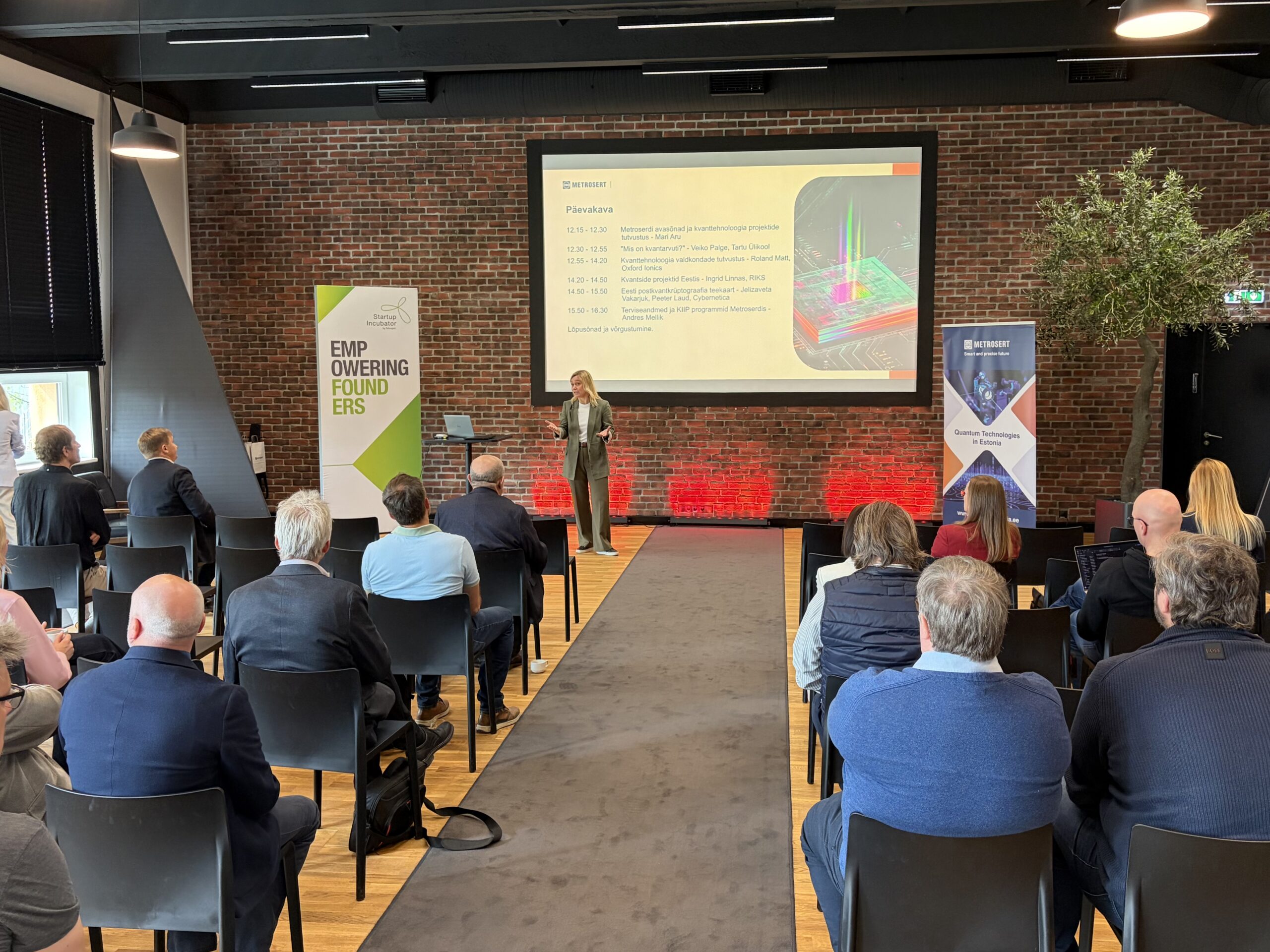

On May 18, the Estonian Association of Information Technology and Telecommunications (ITL) and Metrosert organized a quantum technology seminar for ITL members at the Tehnopol Science and Business Park to introduce the nature, current state, and opportunities of the field.
The seminar was opened by Mari Aru, Head of Metrosert’s R&D Division, who explained the institution’s coordinating role in the Estonian quantum technology sector and its participation in various projects. The experts on stage provided participants with an overview of the different application areas and development trends of quantum technology.
An Insight into the World of Quantum Computing
Veiko Palge, a researcher at the Institute of Physics of the University of Tartu, introduced the nature of quantum computers, their various technologies, and the differences between quantum and classical computing. The presentation noted that quantum computers will likely not replace classical or supercomputers in the future but will instead work together with them as a hybrid solution.

Roland Matt, a quantum architect at Oxford Ionics (IonQ), provided an overview of the main directions of quantum technology: quantum computing, sensors, and quantum communication. The discussion following the presentation covered the specific characteristics of quantum systems, such as superposition and entanglement, and their measurement.
The importance of atomic clocks in finance, navigation, and telecommunications was also explained. Since classical satellite navigation (GPS) can be vulnerable, atomic clocks offer a stable alternative solution. In addition, an interesting fact was highlighted: the unit of measurement for time and frequency is the most crucial unit, through which all other physical quantities can be measured.
Q-Day and Mitigating Security Risks
Quantum communication (QKD, or Quantum Key Distribution) is a cryptographic method whose development is closely linked to preparations for the so-called Q-Day. This is the moment when quantum computers achieve the capability to decrypt current classical cryptographic solutions. QKD ensures secure key distribution based on the laws of quantum mechanics, rather than complex mathematical solutions.
The sector is actively working toward creating an economically viable quantum computer, into which countries are investing extensive resources. Such a system must be powerful enough to bring significant benefits in areas like logistics, finance, or energy. Since the quantum computer will continue to function as a hybrid alongside classical systems, standard processors (CPU), graphics processors (GPU), and quantum processors (QPU) will be used in parallel depending on the operation. Currently, it remains unclear which technological direction will ultimately prove most successful.
Potential development directions for Estonian IT companies were highlighted as:
- Application areas, such as optimization and data management.
- Development of software controlling hardware.
- Creation of new quantum algorithms.
- Development of analog electronics devices (e.g., amplifiers), where there is currently a shortage of specialists in the market.
A current threat is the harvesting of data with the intent to decrypt it in the future (Harvest Now, Decrypt Later). There are two main ways to mitigate this risk:
- Post-Quantum Cryptography (PQC): Computational encryption keys based on mathematical algorithms.
- Quantum Key Distribution (QKD): Key transmission based on quantum mechanics.
Ingrid Linnas from the State Infocommunication Foundation (RIKS) introduced quantum communication in general and Estonia’s activities in this field in more detail. During the EstQCI project, which ran from 2023 to 2025, the first test networks were established through international cooperation in laboratories, within the city of Tallinn, and between government cloud data centers, aiming to develop local competence for procuring and using the technology.
At the beginning of 2026, the follow-up project NordicQCI was launched, under which the first international terrestrial quantum communication links will be built between Estonia, Finland, and Sweden. Cooperation with Sweden will also allow Estonia to develop expertise in satellite-based quantum communication.
An overview of post-quantum cryptography and Estonia’s PQC roadmap was provided by Jelizaveta Vakarjuk from Cybernetica. Post-quantum cryptography is a critical security layer for protecting sensitive data, and the transition to it will begin in the coming years. The specific impacts and stages of the process are described in the recently published Estonian post-quantum cryptography roadmap.
Chip Technology and Health Data
The seminar day concluded with Andres Mellik from Metrosert, who gave an overview of the KIIP and Health Data programs.
The Chip Competence Center KIIP is part of a pan-European network, and its goal is to support companies—especially small and medium-sized enterprises (SMEs) and startups—in developing chip design capabilities. The center ensures access for Estonian companies and research institutions to the European Chips JU pilot lines and design platforms.
The chip center focuses on three types of companies:
- Fabless companies, which design chips but do not manufacture them themselves.
- Companies offering chip design services.
- Technology companies developing application-specific integrated circuits (ASIC) or electronic devices.
At the European level, support is offered in three main areas: hardware security (protection against cyberattacks), testing and safety (quality assurance), and functional verification (checking compliance with specifications). The KIIP consortium includes the Estonian Business and Innovation Agency (EIS), Metrosert, the Estonian Electronics Industries Association (EETL), and Tallinn University of Technology (TalTech).
Finally, Metrosert’s health data unit was introduced, which operates as an independent health data validation center, supporting companies in developing innovative health solutions.
Conclusion: It Is Not a Question of “If,” but “When”
The seminar confirmed that quantum technology is no longer a distant future prospect but requires a proactive and strategic approach from companies today. The active interest of the participants and the discussions that took place demonstrate companies’ desire to explore the threats and opportunities of quantum technology from their own perspective.
Estonia has a clear opportunity and potential to take a leading role in developing both innovative software and hardware. Several companies are already taking steps to mitigate risks and integrate technology, making tracking field trends and responding in a timely manner strategically important.
Quantum Hackathon in Autumn
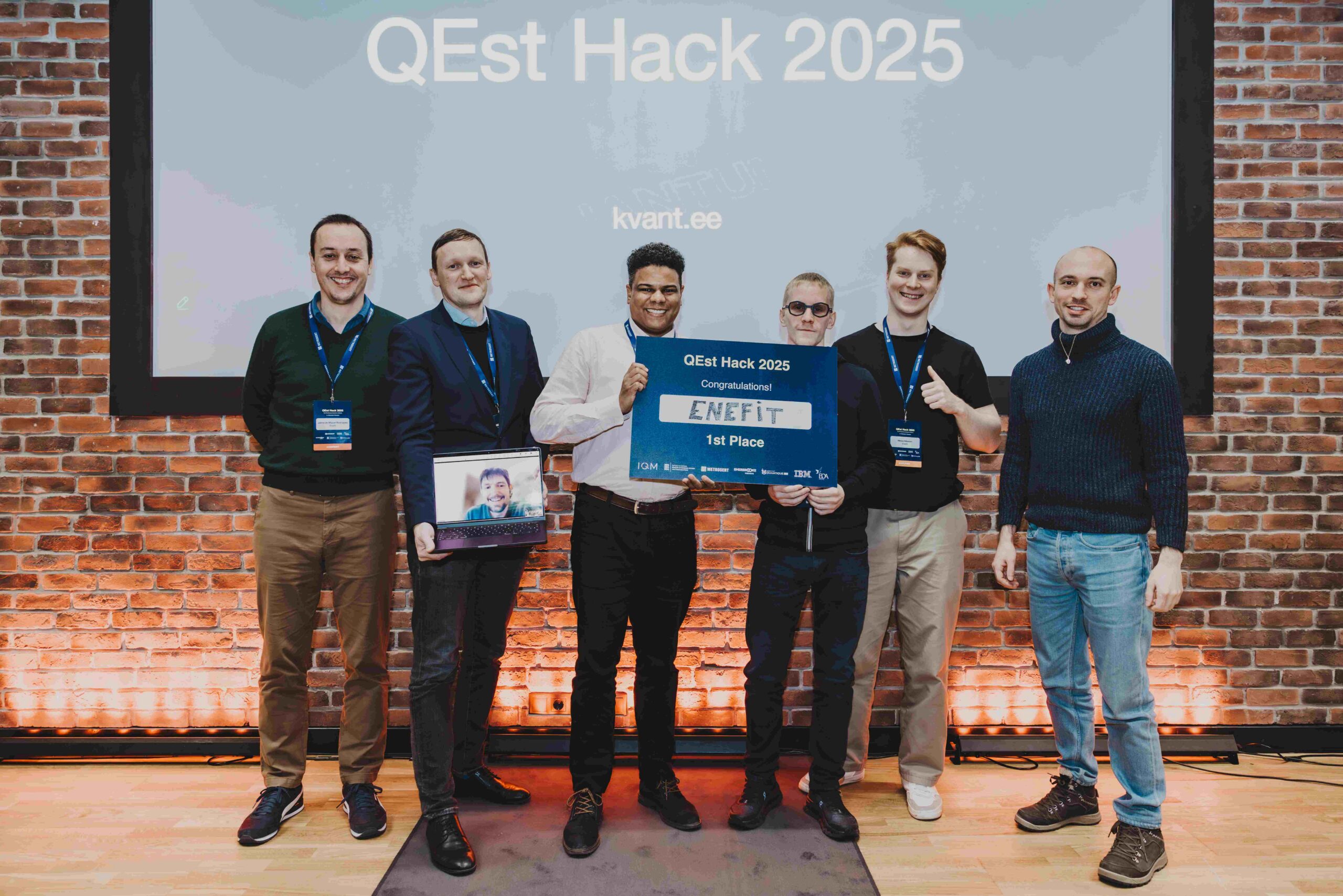
To ensure that theoretical knowledge serves business goals, Metrosert will organize a quantum hackathon again this coming autumn. This is an opportunity for companies to acquire basic knowledge of quantum computing and test the development of solutions for real business challenges. Feedback from last year’s participants confirms that this format offers valuable practical experience and lays the foundation for adopting new technologies.
Stay tuned to our activities! We will soon publish more information about the event and registration for the autumn quantum hackathon. Find out more about quantum technology in Estonia at kvant.ee.