
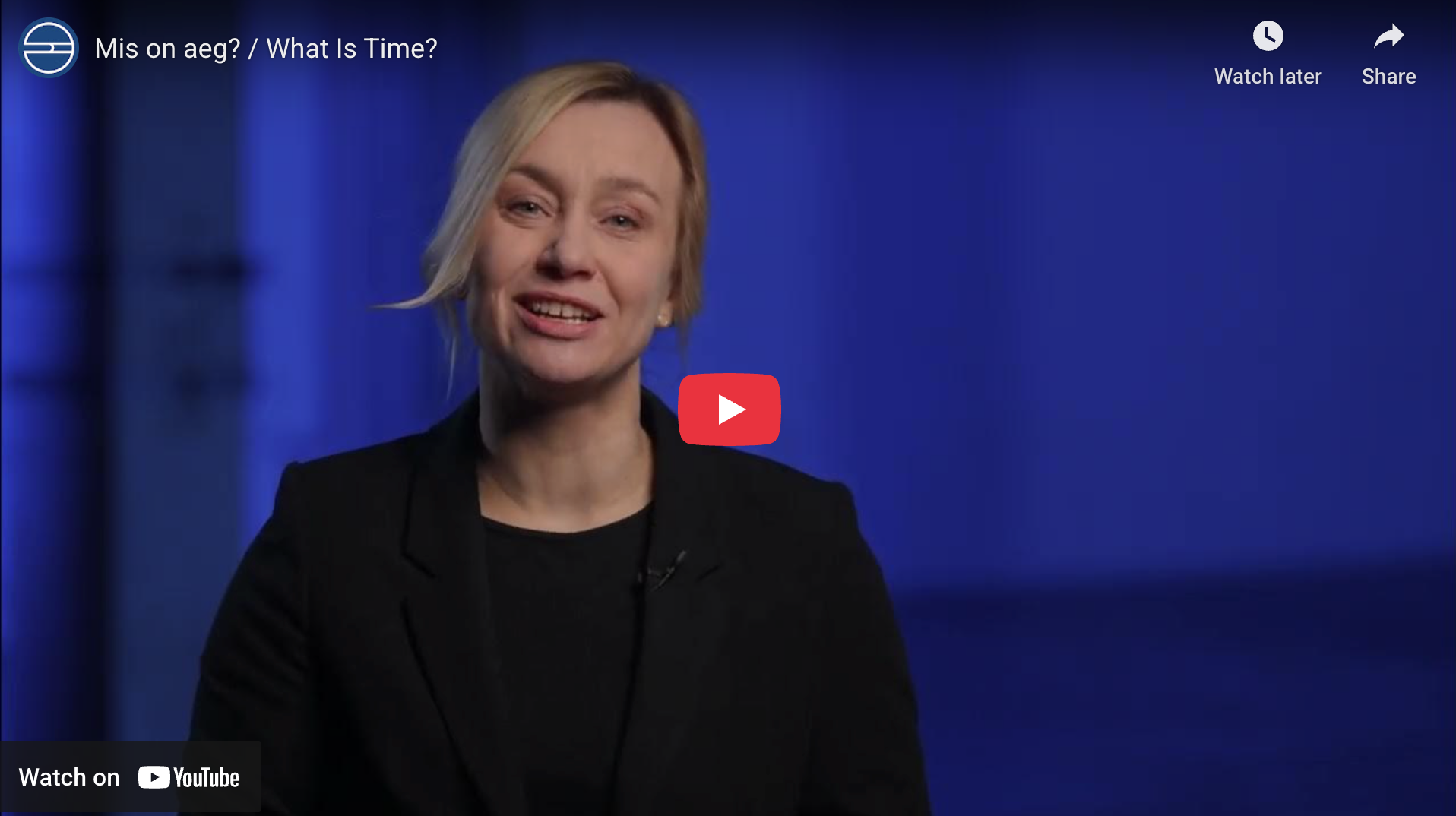
In the latest episode of the short video series “Measured World,” dedicated to the 150th anniversary of the Metre Convention, we focus on the second – the unit that governs our everyday life, from alarm clocks to satellite signals.
According to Mari Aru, Metrosert’s Head Research and Development Division, measuring time is one of the first things we encounter every morning, even though we rarely think about how precisely it is defined.
“Sometimes it feels like time moves too fast or too slowly. But the second itself is a firmly defined SI-unit,” Aru explains.
Historically, the definition of the second was based on dividing the day into hours, minutes and seconds. In the Middle Ages, with the introduction of mechanical clocks, timekeeping became more precise, and the pendulum clock invented in 1656 marked a major step forward – its mechanical movement followed the rhythm of one second.
In the late 18th century, during the French Revolution and the creation of the metric system, an attempt was made to convert time measurement entirely to the decimal system.
“If this had succeeded, our understanding of time and daily rhythm would be completely different today – for example, a week would have 10 days and one minute would contain 100 seconds,” Aru notes.
However, technological progress revealed that the rotation of the Earth is not stable enough to serve as the basis for defining the second. Quartz clocks – and later atomic clocks – showed that the length of a day varies. For this reason, in 1967 the second was redefined using a physical phenomenon: the fine structure of the energy levels of the caesium atom.
“Today, work is underway to redefine the second using optical clocks, which offer even greater precision for the future of science and technology,” adds Mari Aru.
Metrosert carries out scientific and development activities related to SI units in Estonia, maintains and develops national standards, and ensures that measurements in Estonia rely on an internationally recognized and reliable measurement system. In this context, precise time is becoming increasingly important for Estonia.
“Many technologies – 5G networks, radar systems, satellite navigation – function correctly only when their time signals are highly accurate. Until now, we have relied solely on external time sources, but in 2026 Estonia will have its own time standard laboratory,” she explains.
Metrosert is building a caesium clock–based system that will enable Estonia to provide reliable domestic time signals for companies and public services. “This means that Estonia will gain its own national precise time capability,” Aru adds.
The video series Measured World, dedicated to the 150th anniversary of the Metre Convention, introduces SI units, various measurement fields, and future perspectives on precise measurements. The series features metrologists and scientists who explain how accurate measurements contribute to our daily lives and the development of the world. Watch other episodes.
The series received second prize in the 2025 Science Popularization Awards in the category “Popularization of Science and Technology through Audiovisual and Electronic Media.”